


By Dr. Neha Gera, Homeopathic Physician & Senior Homoeopathic Consultant
When a child or young person develops white patches on the skin, one of the first questions parents usually ask is:
“Why is this spreading so quickly?”
This was exactly the concern of a young patient who came to me with her mother. The vitiligo had appeared only a short while earlier, but the patches were already spreading to different parts of the body.
What made the situation more concerning was the speed at which the changes were occurring.
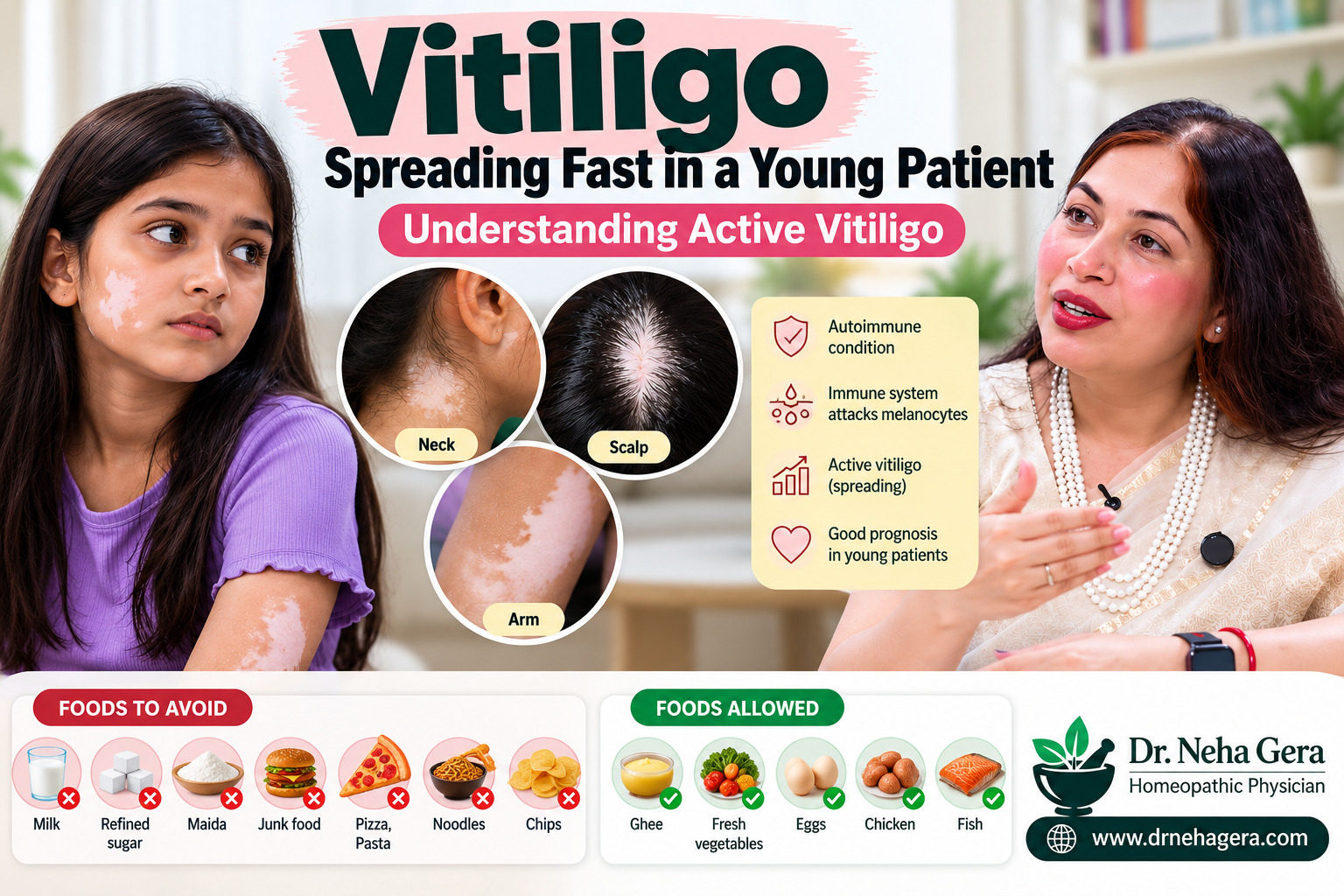
The mother explained that the white patches had started appearing in May. Within approximately two months, there were already multiple areas of involvement.
There was also early involvement of the hair.
Naturally, the mother wanted to know why this was happening and whether there was anything in the family history that could explain it.
She confirmed that there was no known family history of vitiligo on either the maternal or paternal side.
This is an important part of understanding the individual case. Every patient has a different history, and I believe treatment should begin with understanding that history rather than looking at the skin patches in isolation.
In this consultation, I explained to the mother that the patient's presentation suggested active vitiligo, because the patches were continuing to appear and spread.
Vitiligo is associated with an autoimmune process. In simple terms, the immune system becomes involved in attacking melanocytes, the cells responsible for producing pigment.
When the disease is actively spreading, the priority is not simply to look at the existing white patches. We also need to consider what may be driving the continued progression.
That is why I discussed the autoimmune component with the patient's mother and explained the treatment approach accordingly.
For parents, seeing one small white patch is already worrying.
Seeing several new patches appear within a matter of weeks can be frightening.
In this case, the rapid appearance of patches and the early involvement of hair made it particularly important to address the situation at an early stage.
At the same time, I reassured the mother that the patient's young age gave us a good reason to remain hopeful about the possibility of recovery.
The focus was therefore not on creating fear, but on starting an appropriate and individualized treatment approach.
One thing I always try to explain to patients is that the visible patch is only one part of the problem.
When we see a white patch, it is natural to focus entirely on the skin. But in an autoimmune condition, we also need to think about what is happening within the body.
For this young patient, the treatment plan was therefore designed around addressing the autoimmune response and supporting the body's natural healing and repigmentation process.
The treatment was individualized rather than being approached as a standard prescription for every person with vitiligo.
Along with the treatment, we discussed dietary changes.
The approach discussed with this patient was to reduce foods that were considered inflammatory triggers in her individual plan.
The foods advised to be avoided included:
The diet included foods such as:
The intention was to simplify the diet and reduce the intake of foods that were being considered potential triggers while the treatment was underway.
When vitiligo is spreading rapidly, parents often feel helpless because the changes can happen faster than they expected.
My advice is not to ignore newly appearing patches or simply wait for them to settle on their own.
A proper clinical assessment is important, particularly when the patches are appearing rapidly or when there are other areas of involvement such as the hair.
In this young patient's case, the rapid progression was the reason we considered it an active phase of vitiligo and planned the treatment accordingly.
Vitiligo does not look exactly the same in every patient.
The age of the patient, the pattern of the patches, how quickly they are appearing and the individual history all matter when deciding how to approach a case.
This is why I prefer to understand the complete case rather than simply treating the appearance of the white patches.
For this young patient, the objective was to address the autoimmune response, support natural repigmentation and make appropriate dietary changes alongside individualized homeopathic treatment.
If your child suddenly develops white patches, it is understandable to become anxious, particularly when you notice new patches appearing within a short period.
But fear should not be the first response.
The first step should be proper evaluation and understanding whether the condition is stable or actively progressing.
In the case discussed here, the vitiligo was spreading rapidly, but because the patient was young, I also wanted the family to approach the situation with hope and a clear treatment plan.
Early attention, careful observation and an individualized approach can make a significant difference in how confidently a family deals with a condition like vitiligo.
About Dr. Neha Gera
Dr. Neha Gera
Homeopathic Physician & Senior Homoeopathic Consultant
Website: www.drnehagera.com
Disclaimer
This article is based on the clinical discussion presented in the accompanying video and is intended for educational purposes. Individual cases of vitiligo can differ considerably, and diagnosis and treatment should be decided after an appropriate consultation with a qualified healthcare professional. The experience or treatment approach described in this article should not be taken as a guarantee of results for every patient.
Powered By

Copyright © 2026 Dr Neha Gera, All Rights Reserved.


